This guide explains what each grade means at the main grading companies, using their own published standards. It does not cover what a grade is worth: that depends on the card and changes all the time. For how to choose a grader and what it costs from the UK, see our grader comparison and UK grading guide.
What does PSA 10 mean?
PSA 10, GEM-MT (Gem Mint), is PSA's top grade. PSA describes it as "a virtually perfect card": four perfectly sharp corners, sharp focus and full original gloss, with no staining. It allows a slight printing imperfection if it does not spoil the card's appeal. Centring must be within about 55/45 on the front and 75/25 on the back.
What is the difference between PSA 9 and PSA 10?
A PSA 9, MINT, looks like a Gem Mint 10 at first glance but has one minor flaw: for example a very slight wax stain on the back, a minor printing imperfection or slightly off-white borders. Its centring limits are looser too: about 60/40 to 65/35 on the front and 90/10 on the back, against 55/45 and 75/25 for a 10.
On modern Pokémon cards the difference is often a single print line, a tiny speck of edge whitening or centring just outside 55/45. PSA notes that a print defect can be the reason a card that is otherwise Mint does not make a 10.
Graded slabs in stock
All graded slabs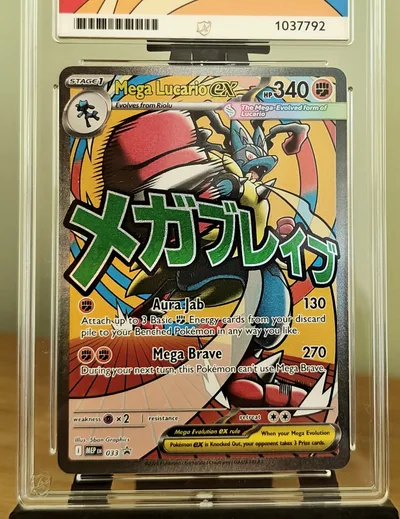

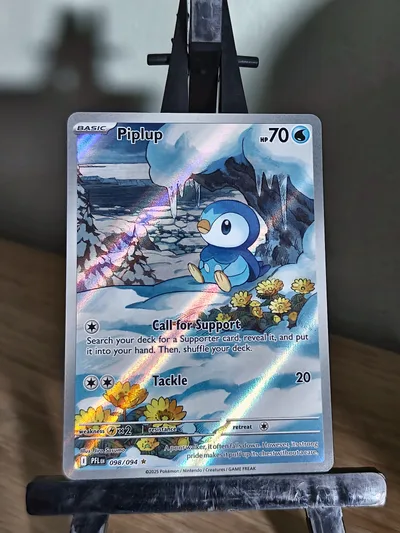
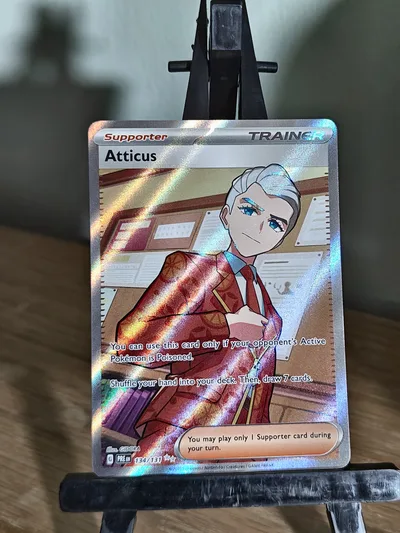
Every card is photographed front and back as sold: the card in the photo is the card you get.
What does PSA 8 mean?
A PSA 8, NM-MT (Near Mint-Mint), is what PSA calls a super high-end card that looks like a Mint 9 at first glance. Look closer and you can see a few minor flaws, such as slight fraying at one or two corners. Front centring can be about 65/35 to 70/30, and the back about 90/10.
What is the full PSA grading scale?
PSA grades cards from 1 to 10. Each grade has a name, abbreviated on PSA's population report. Since February 2008 PSA has also given half grades from 1.5 to 8.5 for cards that show high-end qualities within a grade; there is no 9.5. The old single grade of 1 was split into Poor 1 and Fair 1.5 at the same time.
| Grade | PSA name |
|---|---|
| 10 | GEM-MT (Gem Mint) |
| 9 | MINT |
| 8 | NM-MT (Near Mint-Mint) |
| 7 | NM (Near Mint) |
| 6 | EX-MT (Excellent-Mint) |
| 5 | EX (Excellent) |
| 4 | VG-EX (Very Good-Excellent) |
| 3 | VG (Very Good) |
| 2 | GOOD |
| 1.5 | FR (Fair) |
| 1 | PR (Poor) |
Each step down allows more wear to corners, edges and surface and looser centring. PSA allows a 5% leeway on front centring for cards graded NM 7 or better, and says graders may use eye appeal to decide borderline cases.
What do OC, MK and other PSA qualifiers mean?
A qualifier is added when a card meets a grade's standard apart from one flaw. A card with all the qualities of an 8 but 90/10 centring could be graded NM-MT 8 OC. PSA lists six: OC (off-centre), ST (staining), PD (print defect), OF (out of focus), MK (marks, such as writing) and MC (miscut). Since 2021 PSA has mostly reflected the first four in a lower number instead.
What if PSA will not grade a card?
PSA will not grade cards showing trimming, restoration, recolouring, altered stock or cleaning, or cards of questionable authenticity. These come back unslabbed and the grading fee is still charged. At the grader's discretion, and only if you ask for it on the form, an altered card can be slabbed as Authentic Altered instead of a number. PSA never slabs a card it judges of questionable authenticity.
How do CGC grades work?
CGC uses 1–10 with half grades all the way up, and two 10s: Pristine 10 (perfect 50/50 centring) above Gem Mint 10 (front centring about 55/45, back 75/25). So CGC has a 9.5, Mint+, which PSA does not. Cards that are genuine but cannot be graded get an Authentic or Authentic Altered designation.
| Grade | CGC name | Front centring (top grades) |
|---|---|---|
| 10 | Pristine | 50/50 |
| 10 | Gem Mint | About 55/45 (back 75/25) |
| 9.5 | Mint+ | — |
| 9 | Mint | 60/40 or better (back 90/10) |
| 8.5 / 8 | NM/Mint+ / NM/Mint | 65/35 or better |
| 7.5 / 7 | Near Mint+ / Near Mint | 65/35 / 70/30 or better |
| 6.5 to 1 | Ex/NM+ down to Poor | — |
CGC's other designations: AU (Authentic) for a genuine, unaltered card that cannot take a number, for example because it is below minimum size; AA (Authentic Altered) for a card that has been altered, such as by trimming or recolouring.
How do Beckett (BGS) grades work?
Beckett grades in half points from 1 (Poor) to 10 (Pristine) and gives four subgrades: centring, corners, edges and surface. The label colour shows the band: Black for a Pristine 10 with four perfect 10 subgrades, Gold for Pristine 10 and Gem Mint 9.5, Silver for everything else. So a BGS 9.5 is already a Gem Mint grade.
A Black Label needs 50/50 centring on the front and 55/45 or better on the back, with flawless corners, edges and surface. The subgrades show where a card lost points, which helps if you plan to compare copies.
How do ACE grades work?
ACE, the UK grader, uses whole numbers from 1 to 10 with no half grades: 10 Gem Mint, 9 Mint, 8 Near Mint-Mint, 7 Near Mint and so on down to 1 Poor. It publishes front and back centring limits for every grade, and it says it provides subgrades for corners, edges, surface and centring free of charge.
| Grade | ACE name | Front centring | Back centring |
|---|---|---|---|
| 10 | Gem Mint | Better than 60/40 | Not stated |
| 9 | Mint | Better than 65/35 | Better than 70/30 |
| 8 | Near Mint-Mint | Better than 70/30 | Better than 75/25 |
| 7 | Near Mint | Better than 75/25 | Better than 80/20 |
| 6 to 4 | Excellent-Mint, Excellent, Very Good | Better than 80/20 | Better than 80/20 |
| 3 to 1 | Good, Fair, Poor | Better than 85/15 | Better than 85/15 |
ACE also uses qualifiers: OC when the centring is two or more grades below the overall grade, and MC for a miscut. Cards it finds altered or counterfeit are charged and returned raw; cards of questionable authenticity are returned raw and not charged.
What about TAG grades?
TAG, a US grader, gives a 1–10 grade with half points except between 9 and 10, plus a TAG Score from 100 to 1000. A score of 990–1000 is a Gem Mint 10 and 950–989 is a Mint 10; TAG says its Pristine grade goes beyond Gem Mint and covers under 1% of the cards it grades.
Is a PSA 10 the same as a CGC or ACE 10?
Not exactly. The top grades are close, but the steps differ: CGC and Beckett split 10 into Pristine and Gem Mint and have a 9.5; PSA has no 9.5; ACE has no half grades at all. Centring limits for a 10 range from 50/50 (CGC Pristine, BGS Black Label) to better than 60/40 (ACE Gem Mint).
Because of this, you cannot convert one grader's number into another's. A card that crosses from one slab to another may get a different grade. CGC, for example, says it only takes a card out of a PSA, Beckett or SGC holder if it believes the card will get the same grade or higher, unless you ask it to "cross at any grade"; otherwise the card comes back in its original holder and the full fee still applies.
How do grades relate to raw card conditions?
Raw (ungraded) cards are sold by condition words rather than numbers. Our singles use five: Mint, Near Mint, Lightly Played, Played and Damaged. These are a seller's description, not a grader's verdict, so a card sold as Near Mint is not a promise of any particular grade. Our condition guide explains each one.
If you want to estimate a grade before you submit, check centring, corners, edges and surface under a bright light, then use our grading checklist to see whether the cost makes sense. You can see graded slabs we have in stock on our graded page, raw cards on our singles page, and if you would rather sell than grade, see sell your cards.
Questions people ask
What does PSA 10 mean on a Pokémon card?
PSA 10 is Gem Mint, PSA's top grade: a virtually perfect card with four sharp corners, sharp focus, full original gloss, no staining and front centring within about 55/45 (75/25 on the back).
What is the difference between a PSA 9 and a PSA 10?
A PSA 9 (Mint) looks like a 10 at first glance but has one minor flaw, such as a minor printing imperfection or slightly off-white borders, and may be centred up to about 60/40–65/35 on the front.
Is there a PSA 9.5?
No. PSA gives half grades from 1.5 to 8.5 only. CGC and Beckett do use 9.5.
What does OC mean on a PSA slab?
OC means off-centre: the card met the standard for its grade except for centring. PSA now usually reflects centring in the number instead, but OC labels still exist.
What is a BGS Black Label?
A Beckett Pristine 10 with four perfect 10 subgrades (centring, corners, edges and surface). Gold labels cover Pristine 10 and Gem Mint 9.5; Silver labels cover lower grades.
Does ACE give half grades?
No. ACE grades in whole numbers from 1 to 10 and provides subgrades for corners, edges, surface and centring free.
Graded slabs in stock
Every slab is photographed as sold, so the label and case in the photos are the ones you get. Got slabs of your own to sell? Ask us for an offer.
Sources
- PSA — Grading Standards, read 16 October 2026
- PSA — Grading Your Cards (older article: Gem Mint centring 55/45–60/40), read 16 October 2026
- PSA — Introducing PSA Half Grades, read 16 October 2026
- PSA — Population report (grade abbreviations PR1 to GEM-MT10), read 16 October 2026
- PSA — Lingo: Qualifier, read 16 October 2026
- PSA — Do your cards suffer from "PD"?, read 16 October 2026
- PSA — FAQ (cards PSA will not grade), read 16 October 2026
- PSA — Submission Services Terms and Conditions (Authentic Altered), read 16 October 2026
- CGC Cards — Grading scale, read 16 October 2026
- CGC Cards UK — Services & Fees (crossover policy), read 16 October 2026
- Beckett — Card Grading (scale, subgrades, label colours), read 16 October 2026
- Beckett News — BGS Black sparks added interest in perfect 10s, read 16 October 2026
- ACE Grading — Grading Scale, read 16 October 2026
- ACE Grading — Home (free subgrades), read 16 October 2026
- TAG Grading — Grading Scale, read 16 October 2026
Last updated 16 October 2026.