This guide walks round a modern card from top to bottom, then covers the extra marks on older cards and the difference between holo and reverse holo. The worked example is Noctowl 115/142 from Stellar Crown (2024), which Bill's Archive labels part by part.
What does the top of a Pokémon card show?
The top line tells you what the card is in the game. Top left is the stage (Basic, Stage 1 or Stage 2), then the Pokémon's name. Top right is its HP, the damage it can take before it is Knocked Out, and a symbol for its type, such as Fire, Water or Colourless.
- Stage: a Basic Pokémon can be played straight onto the table. A Stage 1 is played on top of the Pokémon it evolves from, which is named in small print near the stage ("Evolves from Hoothoot" on Noctowl).
- Name: the Pokémon's name, plus any suffix such as ex. A suffix changes the rules (see rule boxes below) and usually the rarity.
- HP: hit points. Noctowl has 100 HP.
- Type: the coloured symbol beside the HP. It matters for weakness and resistance. Bill's Archive notes that Fairy was a type from the XY era until 2020; Fairy Pokémon are now printed as Psychic.
What is the line under the picture?
Under the artwork, modern cards print a short species bar: the Pokédex number, the category (Noctowl is "the Owl Pokémon"), height and weight. It has no effect on the game.
Just added: singles in stock
All singles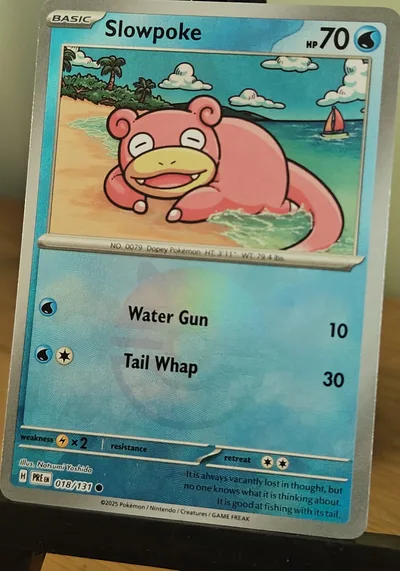
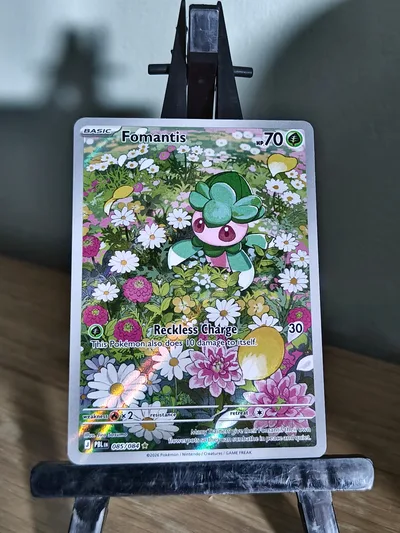
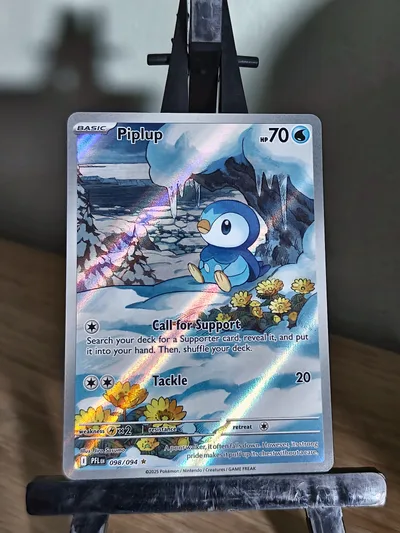
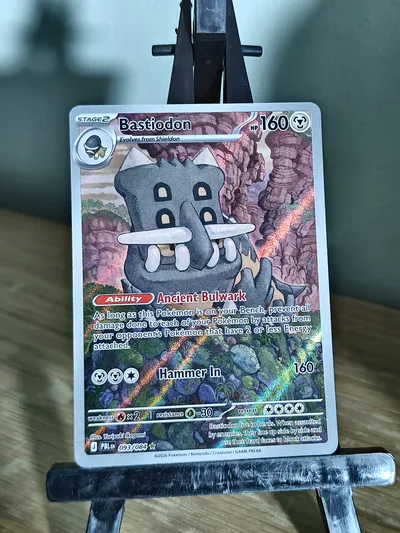
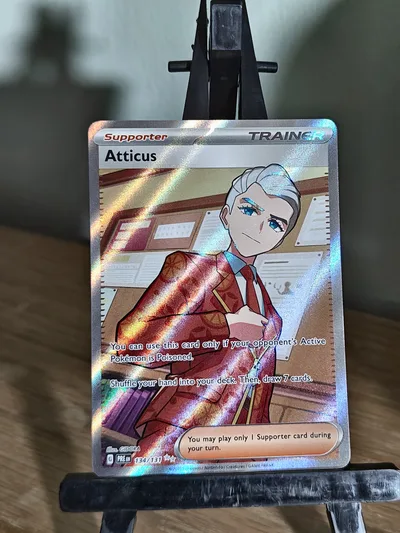
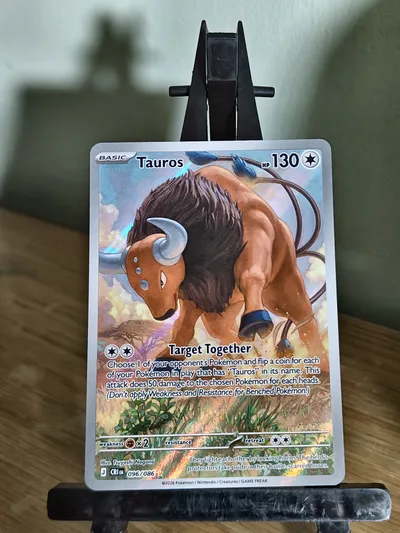
Every card is photographed front and back as sold: the card in the photo is the card you get.
How do attacks, abilities and energy costs work?
The middle of the card lists what the Pokémon can do. An Ability is a power with no energy cost. Each attack shows its energy cost as symbols on the left, its name in the middle and its damage on the right. Noctowl's Speed Wing costs two energy of any type and does 60 damage.
Older cards used other names for abilities. Bill's Archive notes that Wizards-era cards said Pokémon Power, the EX era used Poké-Power and Poké-Body, and Ability has been used since 2011.
What do weakness, resistance and retreat mean?
These three sit in a row below the attacks. Weakness is the type that does double damage (shown as ×2). Resistance is a type that does 30 less damage (−30). Retreat is how many energy you must discard to swap the Pokémon out of the active spot. Bill's Archive notes that some older sets used +10, +20 or +30 weakness and −20 resistance instead.
| Box | Noctowl shows | What it means |
|---|---|---|
| Weakness | Lightning ×2 | A 60-damage Lightning attack does 120 |
| Resistance | Fighting −30 | Fighting attacks do 30 less |
| Retreat | One energy symbol | Discard one energy of any type to retreat |
What is a rule box?
A rule box is a panel of special rules printed on certain cards. On a Pokémon ex it says your opponent takes two Prize cards when it is Knocked Out instead of one. Mega Evolution Pokémon ex give up three. Trainer cards use a similar box: a Supporter reminds you that you can play only one Supporter a turn.
The same Pokémon can appear in one set as an ordinary card and as an ex. They are different cards with different numbers, so check both name and number before you buy or sell.
What do the symbols at the bottom of a Pokémon card mean?
The bottom strip is the part collectors read. From left to right on a modern card: the illustrator credit, the regulation mark in a small box, the set code with a language code, the card number over the set total, and the rarity symbol. Older cards print a set symbol in place of the code and have no regulation mark.
- 1.
Illustrator
"Illus." followed by the artist's name. Noctowl reads "Illus. matazo". Collectors often chase a favourite artist across sets, so the credit is worth noting.
- 2.
Regulation mark
A capital letter in a white box. Noctowl's is H. It tells players whether a card is legal in the Standard tournament format. Regulation marks started in 2020 with the letter D; cards with no mark are not legal in Standard. It is not a rarity.
- 3.
Set code and language
SCR EN on Noctowl: SCR is Stellar Crown and EN means English. Sets before Scarlet & Violet (2023) print a small picture symbol instead. Our guide what set is my Pokémon card from? explains how to look either one up.
- 4.
Card number
115/142: card 115 of the 142 in the main set. A number above the total, such as 188/132, marks a "secret" card printed after the main list. Promo cards have a number with no total.
- 5.
Rarity symbol
A circle is Common, a diamond Uncommon, a black star Rare. Modern sets add multiple and coloured stars for the higher rarities; our rarity guide explains each one.
Where is the copyright line, and why does it matter?
The copyright line is the small print along the very bottom, giving the year (Noctowl reads ©2024) and the companies that own the game. It helps date a card, and on the 1999 Base Set it separates print runs: the fourth English run is identical to Unlimited except its line reads 1999–2000.
Our Base Set guide covers the four Base Set runs, the 1st Edition stamp and the "shadowless" frame in detail.
What is different on old Pokémon cards?
Wizards of the Coast cards (1999 to 2003) have the set symbol at the bottom right of the picture frame, no regulation mark and no set code. The 1999 Base Set has no set symbol at all. Many also exist in a 1st Edition print.
- 1st Edition stamp: a small "Edition 1" stamp on the front, usually on the opposite side of the picture from the set symbol. Bulbapedia lists English 1st Edition runs for every set up to and including Neo Destiny, except Base Set 2.
- Rarity: the same circle, diamond and star symbols, but before Scarlet & Violet every rare tier shared one black star. Bill's Archive notes that the premium tiers were told apart by the card's style (for example a holo or full-art card) rather than by the symbol.
- Black Star promos: Wizards-era promos carry a black star in place of the set symbol and their own numbering.
What is the difference between holo and reverse holo?
A holo (holofoil) card has a shiny foil finish on the artwork. A reverse holo has the foil everywhere except the artwork. Bulbapedia records that reverse holos were introduced in Legendary Collection (2002). Many modern cards exist as both a normal and a reverse holo version with the same number.
Holo and reverse holo copies are listed separately by sellers and price trackers, so say which you have. The TCGdex card database lists the versions each card was printed in; Staryu 120/165 from 151, for instance, exists as a normal and a reverse holo.
What about Trainer and Energy cards?
Trainer cards have a label in the top-left corner showing their kind, such as Supporter or Stadium, with the effect printed in the middle. A Supporter carries a short rule box (one Supporter a turn); a Stadium stays in play until another Stadium or a card effect replaces it. ACE SPEC cards are marked with that name in bold colouring. Energy cards are what attack costs are paid with.
The bottom strip on Trainer and Energy cards works the same way: illustrator, regulation mark, set code, number and rarity.
Next steps
Once you can read the card, check its condition with our condition guide; condition, set, number and variant together decide which listings it matches. If you are looking for a specific card, our singles are photographed as sold, so the card in the photo is the card you get, and slabbed cards are on our graded page. Have cards to sell? See sell your cards.
Questions people ask
What do the numbers at the bottom of a Pokémon card mean?
The number such as 115/142 is the card's number in its set over the number of cards in the main set. A first number higher than the second (for example 188/132) marks a secret card printed after the main list. Promos have a number with no total.
What is the letter in a box at the bottom of my card?
It is the regulation mark. It shows whether a card is legal in the Standard tournament format; marks started in 2020 with D. It is not the set and not the rarity.
Where is the illustrator's name on a Pokémon card?
In the bottom strip of the card, after "Illus.", for example "Illus. matazo" on Noctowl 115/142 from Stellar Crown.
What does the star on a Pokémon card mean?
A single black star means Rare. Two stars, silver stars and gold stars mark the higher modern rarities. A circle is Common and a diamond is Uncommon.
What is the difference between a holo and a reverse holo?
A holo has the foil on the artwork; a reverse holo has the foil everywhere except the artwork. They are different versions of the same card number and are listed separately.
What does ex mean on a Pokémon card?
It marks a Pokémon ex, a stronger card with a rule box: your opponent takes two Prize cards when it is Knocked Out, or three for a Mega Evolution Pokémon ex.
Scarlet & Violet—151: dates, products and stock
Our Scarlet & Violet—151 page has the UK release date, what’s in each product and the chase cards, with whatever we have in stock from the set.
Sources
- Bill's Archive — Pokémon card anatomy: 20 parts labelled (Noctowl 115/142), read 16 October 2026
- Bill's Archive — Set symbols, read 16 October 2026
- Card Gamer — Pokémon cards explained, read 16 October 2026
- Bulbapedia — Pokémon ex (TCG), read 16 October 2026
- Bulbapedia — Rule Box (TCG), read 16 October 2026
- Bulbapedia — 1st Edition (TCG), read 16 October 2026
- Bulbapedia — Legendary Collection (TCG) (introduced reverse holofoil), read 16 October 2026
- PokéGuardian — What does the "D" symbol mean on Sword & Shield cards?, read 16 October 2026
- TCGdex API — Staryu 120 (151): variants normal and reverse, read 16 October 2026
- TCGdex API — Mega Evolution (me01): 132 main cards, 188 total, read 16 October 2026
Last updated 16 October 2026.