This guide is about what to buy. It covers the product types and what each is for, without ranking brands or quoting prices. For where to keep the cards once they are protected, including humidity, light and sealed product, see our guide to storing Pokémon cards.
What should you buy to protect Pokémon cards?
Match the protection to the job. A penny sleeve is the base layer for any card worth keeping. Add a toploader to post or handle a card, a magnetic case to display it, a binder to browse a collection, and a deck box if you play. The table gives the combination for each situation.
| Job | What to buy | Why |
|---|---|---|
| Keeping a card you care about | Penny sleeve, then a toploader or magnetic case | The sleeve protects the surface; the rigid holder stops bends and knocks |
| Posting a card to a buyer | Penny sleeve, toploader, then a card sandwich | Our postage guide shows the full method |
| Browsing a collection | Side-loading, non-PVC binder pages | Cards are visible and held in place; see the binder section |
| Displaying your best cards | Magnetic one-touch case | A hard two-piece case; some are sold as non-PVC and UV-blocking |
| Sending cards for grading | Penny sleeve inside a semi-rigid holder, unless the grader says otherwise | CGC's packing page and PSA's own store describe semi-rigid holders; check the grader's current packing page first |
| Playing a deck | Perfect-fit inner sleeves, deck sleeves and a deck box | Extra protection while shuffling and carrying the deck |
| Bulk cards | A card storage box, with sleeves for any you might sell | See the storage guide |
Which sleeves should you buy: penny, perfect fit or deck?
Penny sleeves are thin soft sleeves: one goes on every card you keep. Perfect-fit sleeves are tight inner sleeves that go under a deck sleeve to double up protection. Deck sleeves are thicker, slightly larger outer sleeves for play. All of them should be standard size for Pokémon cards.
| Type | Stated size | Use |
|---|---|---|
| Penny sleeve (soft sleeve) | Ultra PRO: for 2½ x 3½ in (63.5 x 88.9 mm) cards up to 35 pt, in clear non-PVC, acid-free polypropylene. BCW gives the sleeve itself as 2⅝ x 3⅝ in | First layer on any card worth keeping; the layer inside a toploader |
| Perfect fit (inner sleeve) | Dragon Shield: 63 x 88 mm (2½ x 3½ in), loaded top first, "Layer: Inner" | Under a deck sleeve for a second layer |
| Standard deck sleeve | Ultra PRO: 66 x 91 mm | Cards you play with |
| Small deck sleeve | Ultra PRO: 62 x 89 mm, for games such as Yu-Gi-Oh! and Cardfight!! Vanguard | Not for Pokémon cards |
Ultra PRO's support page lists Pokémon cards under standard-size sleeves. It does not mention Japanese Pokémon cards separately, so if you hold Japanese cards, check the sleeve's stated card size rather than assuming. The Dragon Shield page we read does not state what its perfect-fit sleeves are made of, so check the packaging for a PVC-free, acid-free label. Our Japanese vs English guide covers other differences between the two.
Just added: singles in stock
All singles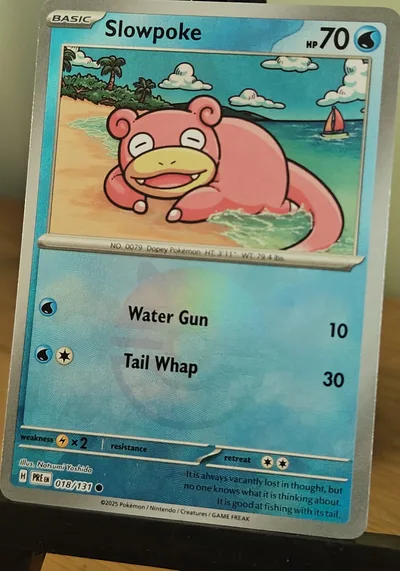
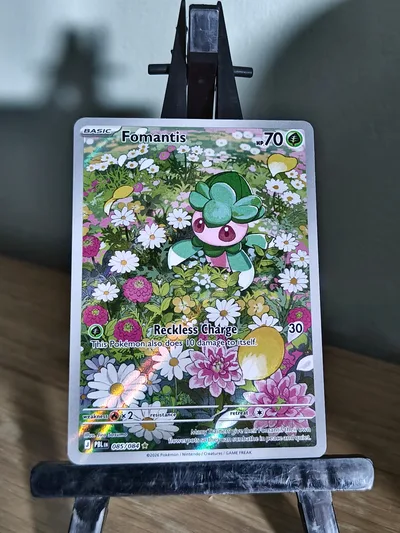
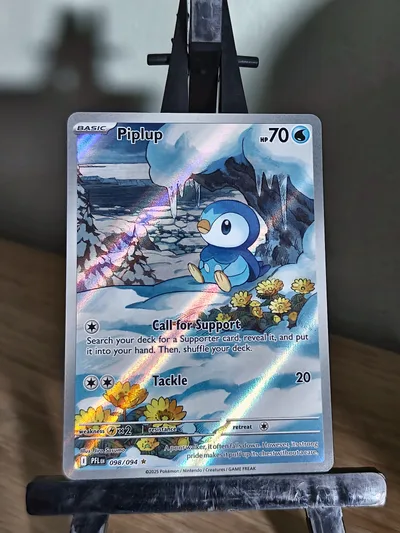
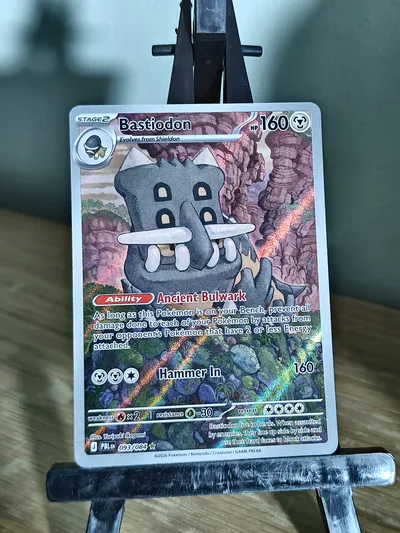
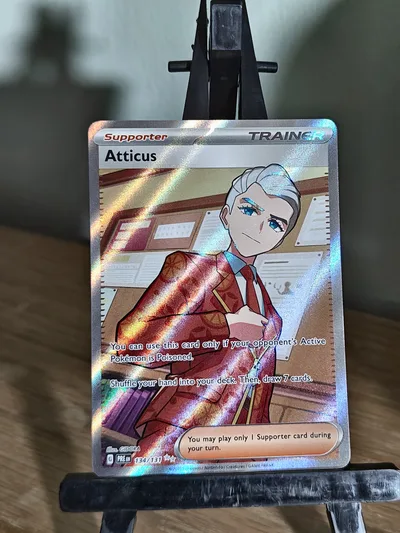
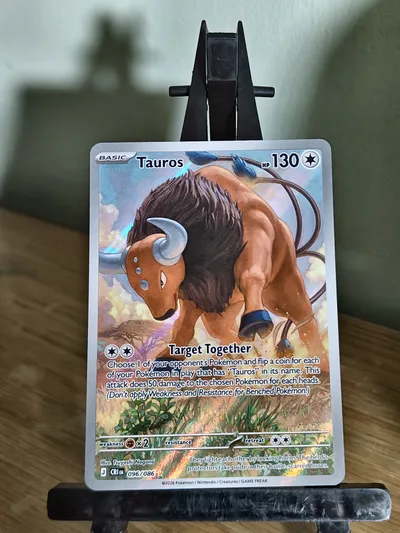
Every card is photographed front and back as sold: the card in the photo is the card you get.
Toploader, semi-rigid holder or magnetic one-touch: which is which?
A toploader is a rigid PVC case that opens at the top, the hobby standard for posting and handling. A semi-rigid holder is a thinner, more flexible case used for grading submissions. A magnetic one-touch is a hard two-piece case with a magnetic closure, sold for long-term display. Always put the card in a penny sleeve first.
| Holder | Stated facts | Best for |
|---|---|---|
| Toploader | BCW's 3 x 4 in model is "crafted from rigid, high-clarity PVC", 12 mil panels, fits cards up to 35 pt, opens on the short side; interior 2¾ x 3⅞ in | Posting, handling and everyday protection |
| Semi-rigid holder | PSA's store lists a 1/2 in lip holder for standard cards "up to 35 points in thickness", "made from clear PVC", and calls semi-rigid tall sleeves "the ideal protection choice for graded card submissions" | Sending cards to a grader |
| Magnetic one-touch | Ultra PRO: "slide-in hinges and a magnetic closure", "non-PVC materials", UV-blocking additives (its claim). Sizes listed from 23 pt to 180 pt, with some 260 pt and 360 pt | Displaying your best cards |
What thickness (pt) of holder do you need?
A standard 35 pt toploader fits ordinary Pokémon cards. BCW says standard cards of 20 to 35 pt fit its standard toploaders, and that thicker cards need holders designed for them. Never force a card into a holder: a bent corner is the usual result. Magnetic one-touch cases are sold in a range of thicknesses for thicker cards.
Does a toploader need a sleeve inside it?
Yes. Ultra PRO's toploader guide says "Always sleeve your card first", because PVC "can rub against the card and yellow over time". BCW's FAQ says using a penny sleeve inside a toploader provides excellent protection. Load a sleeved card gently, and never use tweezers or tools, which Ultra PRO warns against.
Which holder do graders want?
Check the grader's own packing page, because the advice you will find online conflicts. CGC's page says to put each card in a protective sleeve, then in a semi-rigid sleeve. Cardboard Gold quotes PSA as advising against toploaders, hard acrylic cases and screw-down holders, while Ultra PRO's blog says PSA and Beckett generally require toploaders. Neither retailer is the grader.
Our UK grading guide and PSA from the UK guide cover submission routes, and our graded cards are already in slabs.
Are PVC sleeves and binders bad for Pokémon cards?
PVC is a concern for long contact with paper and prints. The US National Archives says PVC plastics "generate acids" and can make printed images transfer to the plastic, and a Canadian conservation bulletin links degraded flexible PVC to staining. We found no testing on Pokémon cards, so treat this as guidance for paper, not proof for cards.
- Soft sleeves and binder pages touch the card for years. Choose polypropylene labelled acid-free and non-PVC. Ultra PRO describes its penny sleeves and side-load binder pages that way.
- Toploaders are normally PVC. BCW states its toploaders are rigid PVC and Ultra PRO says toploaders are usually PVC, which is why a sleeve goes between card and holder.
- For long-term display of your best cards, a case sold as non-PVC, such as a magnetic one-touch, avoids the question.
- Look for the label. If the product page does not say what it is made from, assume nothing.
The National Archives also names polyethylene, polypropylene and polyester as the stable plastic enclosures it recommends in place of PVC. The Canadian bulletin warns against rigid PVC foam boards in contact with objects, which is a different product from a toploader.
What should you look for in a Pokémon card binder?
Look for side-loading pockets, pages made from acid-free non-PVC polypropylene, and pockets sized for standard cards. A zipped binder with 9-pocket pages is the common choice. If you want to keep cards in toploaders, buy an album made for them: standard binder pockets are not.
- Side-loading pockets. Ultra PRO says its side-load pages are "designed with sideloading pockets to minimize cards from falling out of the pockets during transit".
- Material. Ultra PRO describes its pages as "non-PVC, and archival-safe polypropylene film". Vault X lists its binder as "Acid-free / no PVC". These are manufacturers' claims, not independent certification.
- Pocket size and capacity. Vault X's 9-pocket zip binder lists 20 pages, 360 cards and a 68 x 97 mm internal pocket, and says it is compatible with all standard card protector sleeves.
- Toploader albums are a separate product. BCW's Z-Folio is built for standard 3 x 4 in, 35 pt toploaders, and BCW says thicker protectors may not fit. Its listing gives two different capacities (252 toploaders on 14 pages in the description, 360 on 20 pages in the FAQ), so check before you buy.
How you arrange the cards is a different question: see how to organise a Pokémon card collection for set order, master sets and sorting.
Do you need a deck box?
Only if you play. A standard Pokémon deck is 60 cards, and a deck box keeps a sleeved deck together in a bag. Ultra PRO's Pikachu Alcove Tower, for example, holds up to 100 standard-size cards double-sleeved in its Deck Protector sleeves, with a magnetic lid. A deck box is not a place to store a collection.
What are the common mistakes when protecting cards?
The common mistakes are putting a bare card in a toploader, forcing a thick card into a standard holder, buying small-size sleeves, assuming a holder suits a grader, and trusting unlabelled plastic for long-term storage. Each is easy to avoid, as the list shows.
- A bare card in a toploader. Sleeve first, as above.
- Forcing a thick card into a standard holder. Pick a holder rated for its thickness.
- Small-size sleeves on Pokémon cards. Small sleeves are sized for Yu-Gi-Oh! and Vanguard.
- Assuming a holder is acceptable to a grader. Check the grader's page.
- Buying unlabelled plastic for long-term storage. If it does not say PVC-free and acid-free, you do not know.
- Skipping the protection on a card you plan to sell. Our condition guide shows what each grade allows.
How we protect the cards we sell
We post each single in a penny sleeve and a toploader, sandwiched between rigid card in a plain envelope, and every card is photographed as sold. Browse the singles range or the graded slabs, or see our delivery page for how orders go out. Sorting a collection you want to sell? Our sell your cards page has the form.
Questions people ask
Do I need to put a card in a penny sleeve before a toploader?
Yes. Ultra PRO says to always sleeve the card first because PVC can rub against it and yellow over time, and BCW says a penny sleeve inside a toploader provides excellent protection.
What size toploader do Pokémon cards need?
A standard 3 x 4 in, 35 pt toploader. BCW's version has an interior of 2¾ x 3⅞ in and fits cards up to 35 pt. Thicker cards need a holder designed for them.
What is the difference between a toploader and a semi-rigid holder?
A toploader is a rigid PVC case that opens at the top. A semi-rigid holder is thinner and more flexible, and PSA's store describes semi-rigid tall sleeves as the ideal choice for graded card submissions.
Are PVC binders bad for Pokémon cards?
Conservation bodies warn against PVC in long contact with paper and prints, so choose acid-free, non-PVC pages. We found no testing on Pokémon cards specifically.
Can I use small sleeves for Pokémon cards?
No. Ultra PRO lists Pokémon under standard-size sleeves (66 x 91 mm). Small sleeves (62 x 89 mm) are for games such as Yu-Gi-Oh! and Cardfight!! Vanguard.
Every card photographed as sold
Each single is photographed front and back, with its condition stated, and posted from the UK. The card in the photo is the card you get.
Sources
- Ultra PRO — Penny Sleeves 2.5" x 3.5", read 17 October 2026
- Ultra PRO Support — Small vs Standard Sleeves, read 17 October 2026
- Ultra PRO — UV ONE-TOUCH magnetic holders, read 17 October 2026
- Ultra PRO — A Top To Bottom Guide on Toploaders, read 17 October 2026
- Ultra PRO — Premium Series 9-Pocket Side Load Pages, read 17 October 2026
- Ultra PRO — Pikachu Alcove Tower Deck Box for Pokémon, read 17 October 2026
- BCW — 3x4 Topload Card Holder, read 17 October 2026
- BCW — What thickness of toploader do I need?, read 17 October 2026
- BCW — 100 Count Card Sleeve and Toploader Combo Pack, read 17 October 2026
- BCW — Z-Folio 9-Pocket LX Album for Toploaders, read 17 October 2026
- Dragon Shield — Perfect Fit sleeves, read 17 October 2026
- Vault X — 9-Pocket Exo-Tec Zip Binder, read 17 October 2026
- PSA Store — 1/2" Lip Semi-Rigid Card Holders for Standard Size Cards, read 17 October 2026
- CGC Cards — Packing and shipping instructions, read 17 October 2026
- Cardboard Gold — Card Saver I vs Top Loader, read 17 October 2026
- US National Archives — Family Archives: General Guidance, read 17 October 2026
- Canadian Conservation Institute — Technical Bulletin 32: Products used in preventive conservation, read 17 October 2026
- Bulbapedia — Deck (60-card decks), read 17 October 2026
Last updated 17 October 2026.