What counts as Pokémon bulk?
Bulk is the everyday, lower-rarity cards you collect from opening packs: commons, uncommons, ordinary rares, reverse holos, Trainer cards and basic Energy. It is sold by quantity rather than card by card. Nobody fixes the line, so every buyer and buylist sets its own definition, and you should read it before you sort.
Buyers draw the line in different places. One UK buylist, for example, counts commons, uncommons, rares, holos, Trainers, promos and reverse holos as bulk, and accepts bulk Energy without counting it towards the offer. Others leave out reverse holos or rares, so check each buyer’s own definition.
| Pile | How to spot it | Why it gets its own pile |
|---|---|---|
| Commons and uncommons | A circle (common) or diamond (uncommon) beside the card number | Most of any collection; sold by count |
| Reverse holos | Shiny everywhere except the artwork | Some buyers count them with the rest, some separately |
| Ordinary rares and holo rares | A single black star | Often counted separately from commons |
| Trainers | A Trainer label (Item, Supporter, Stadium) at the top | Players look for specific ones |
| Basic Energy | A plain Energy card with no attack or text box | Some buyers will not count it |
The symbols are explained in our rarity guide and our guide to reading a card.
Which cards should you take out of bulk first?
Before anything is sold by the hundred, go through it once for cards worth listing on their own: anything above a black-star rare, full-art cards, Wizards-era cards, stamped promos and popular Trainers. TCGplayer warns that judging by rarity alone means you "might miss out on the Rare, Uncommon, and Common cards that are worth real money".
- Higher rarities. Two or more stars, silver stars or gold stars. Our rarity guide shows each symbol.
- Old cards. Wizards of the Coast cards from 1999 to 2003, and anything with a 1st Edition stamp. See vintage Pokémon cards explained.
- Promos and stamped cards. A promo has a number with no set total; some cards carry a stamp on the artwork.
- Cards players want. Trainers and Pokémon that see tournament play can be in demand whatever their rarity symbol says.
- Japanese and other languages. Keep them apart: some buyers want English only, and a mixed lot is harder to describe.
To check what a single card is selling for, look at sold listings, not asking prices. Our guide to what old cards are worth explains the method. Check condition as you go: creases, water damage and heavy whitening matter, and our card condition checker places a card on our five-step scale if you are unsure.
Just added: singles in stock
All singles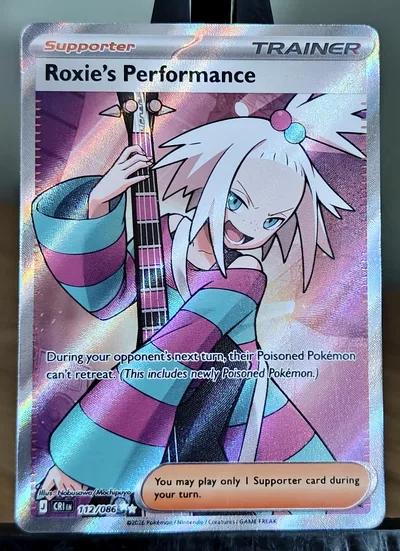
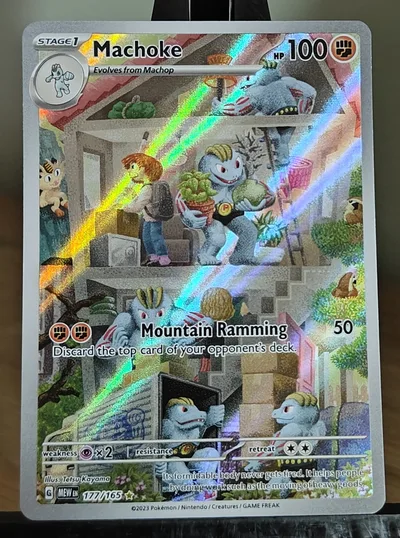
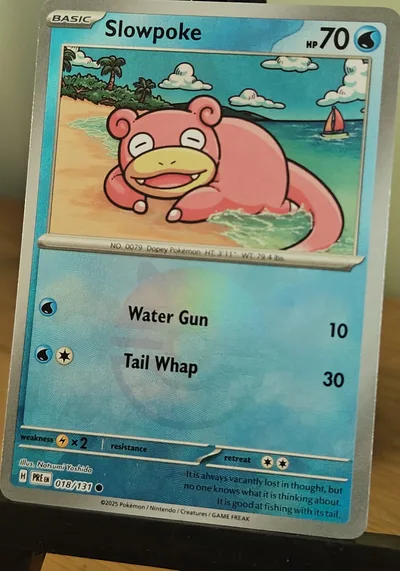
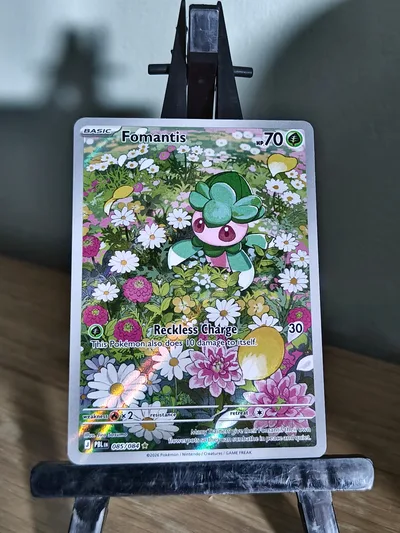
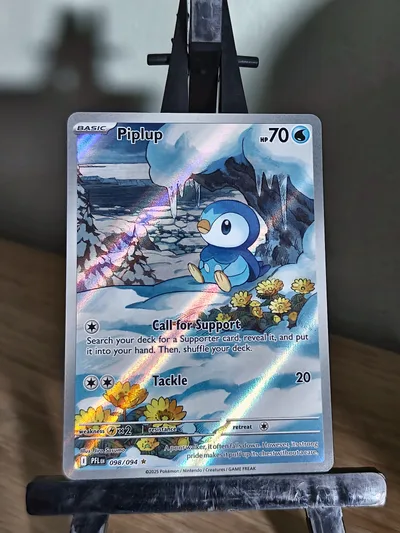
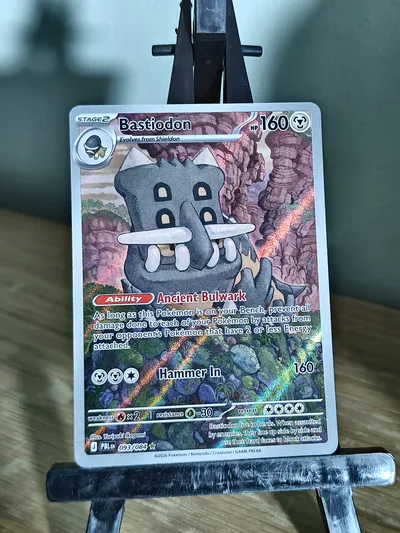
Every card is photographed front and back as sold: the card in the photo is the card you get.
How do you sort Pokémon bulk to sell?
Sort in two passes. First split by kind of card: commons and uncommons, reverse holos, rares, Trainers and Energy. Then, if you are selling to collectors rather than by count, sort each pile by set. A lot that says exactly what is in it is easier for a buyer to judge, and easier for you to describe honestly.
- 1.
Clear a table and wash your hands
Sort on a clean, dry surface with room for several piles, away from drinks.
- 2.
Pull out the keepers
Take out the cards above, and sleeve anything you might sell on its own.
- 3.
Split by kind
One pile each for commons and uncommons, reverse holos, rares, Trainers and Energy. Keep other languages separate.
- 4.
Count by weight
Count one stack of 100 cards and weigh it on kitchen scales. After that you can estimate big piles by weight instead of counting every card, and you know roughly what the parcel will weigh.
- 5.
Sort by set if it helps the buyer
Set collectors hunt for particular numbers, so a lot sorted by set with the sets named is more useful to them. Our guide to completing a set explains what they are looking for.
- 6.
Box it while you decide
Store sorted piles upright in card boxes with labelled dividers. Our organising guide covers bulk storage.
Where can you sell Pokémon bulk in the UK?
The realistic routes are a card shop or online buylist, one lot on eBay, Vinted or Facebook Marketplace for your own cards, and trading with other collectors. Single-card marketplaces such as Cardmarket suit the better cards you pulled out rather than the bulk itself. Which suits you depends on how much time you want to spend.
| Route | Your effort | What it costs you | Watch out for |
|---|---|---|---|
| Shop or buylist | Low: sort to its rules, then post or hand over | No listing fee; an offer is below what you might get selling yourself | Rules on condition, language and Energy; sorting fees on a declined offer |
| eBay lot (private seller) | Medium: photos, description, postage | No final value fee; 300 free listings a month, then 35p each. The buyer pays a Buyer Protection fee on top | Postage on a heavy lot |
| Vinted | Medium: photos, messages, postage | No selling fee; the buyer pays Vinted's fee at checkout | Your own cards only; no new items bought to resell |
| Facebook Marketplace | Medium: messages and meeting | Collection in person avoids postage | Meeting strangers; agree payment first |
| Trading | High: it takes time | Nothing | Few collectors need plain commons |
Should you sell bulk to a shop or buylist?
A shop or online buylist is the quickest way to clear bulk: you sort to its rules, send or take the cards in, and are paid once they are checked. It pays less than selling yourself, because the shop takes on the work of reselling. Read its rules on condition, language, Energy and declined offers before you post anything.
- Read its definition of bulk. Buyers count reverse holos, rares or Energy differently.
- Condition and language. Many buyers mainly accept English cards in near-mint condition.
- Sorting fees. Some buyers charge a small sorting fee, which can still be payable if you decline the offer.
- Store credit or cash. Store credit is often worth more than the cash offer. Credit only helps if you will spend it there.
- Local shops. Ask first whether a shop buys bulk at all, and when, before you turn up with boxes.
- Get the offer agreed before you post. Send by a tracked service and keep proof of postage.
How do you sell a bulk lot on eBay?
List it as one lot: say how many cards, which kinds, the sets or era, the language and the general condition, and photograph the actual cards. eBay says UK private sellers "won't pay final value fees" when items sell; the buyer pays eBay a Buyer Protection fee on top of your price instead.
- Listings. Private sellers get 300 free listings a month; eBay charges 35p for each listing after that.
- The buyer's fee. A flat £0.10 per item plus 7% of the price up to £20, 4% of the part from £20 to £300 and 2% of the part from £300 to £4,000. On several of the same item bought from one listing, eBay says the flat fee is charged only once.
- Describe it honestly. Say whether the rares and holos have been taken out. Calling a picked-through lot "unsearched" misdescribes it.
- Photos. A photo of the sorted stacks, a spread of typical cards and the backs. Never use someone else's photos.
- Buying bulk to resell? Then you are probably a business seller, with different fees: our eBay selling guide explains where the line falls.
Can you sell bulk Pokémon cards on Vinted or Facebook?
Yes, if they are your own cards. Vinted charges sellers no selling fee; the buyer pays Vinted's fee at checkout. Its rules say standard accounts cannot be used to sell professionally. Facebook Marketplace suits collection in person, which saves posting a heavy box. Meet somewhere public and agree payment before you hand over.
- The Vinted fee is paid by the buyer and is "usually 3% to 8% + £0.3 to £0.8", according to Vinted's price list (updated 8 October 2026).
- New commercial stock. Vinted says: "You can't sell new items bought specifically to resell." Bulk from your own collection is not that, but bought-in bulk can be.
- More detail on Vinted's rules, postage and payouts is in our Vinted selling guide.
- Safety. Check a payment has really arrived before posting or handing over. Our scams guide covers the common tricks.
Is trading bulk worth the time?
Trading turns bulk into cards you actually want, with no fees or postage, but it is slow, and few collectors need plain commons. It works best with the better cards you pulled out, with collectors still building a set who need particular numbers, and at local game shops that run play or trade evenings.
- Bring a trade binder of your better duplicates, and keep the plain bulk in a box for anyone after particular numbers.
- Agree the swap and check condition face to face before cards change hands.
- Ask the shop first before trading on its premises.
- Giving it away to a younger collector or a school club clears space and starts someone else's collection.
How much does it cost to post a heavy bulk lot?
Bulk is heavy, so weigh the packed box before you set a price or a postage charge. Royal Mail charges by size and weight, and a big lot can go past the 2 kg Small Parcel limit into a Medium Parcel. Our postage calculator handles up to 100 cards; beyond that, weigh the parcel and use Royal Mail's price finder.
- Small Parcel: up to 45 × 35 × 16 cm and 2 kg. Medium Parcel: up to 61 × 46 × 46 cm and 20 kg (figures from a fulfilment company's summary of Royal Mail's limits; check Royal Mail before you buy postage).
- For up to 100 cards, our card postage calculator works out the format, weight band and Royal Mail's published price for each service.
- Pack it so nothing shifts. Cards stacked upright in a card box, gaps filled, inside a stronger outer box. Loose cards sliding about arrive bent.
- Choose the service by what you would mind losing. Royal Mail's compensation and tracking differ by service; our postage guide has the limits.
- Collection in person avoids all of this, which is why local sales suit big lots.
What will fees take from a bulk sale?
On a low-priced lot, fees and postage are a big share of the sale, so work them out before you list. Our selling fees calculator shows what you keep on eBay, as a private or business seller, and on Vinted, from a sale price you type. Add the postage and packing you pay, then compare that with a shop's offer.
Open the selling fees calculator, type the price you would list the lot at, and add your postage. It never suggests a price: every number is yours.
Do you pay tax on selling bulk Pokémon cards?
Usually not if it is your own collection: gov.uk says that if you are selling personal possessions you probably do not have to pay Income Tax on them. Lots of small sales can still lead to a platform report, which is not a tax bill in itself. Buying bulk to resell is different, and can count as trading.
- Platform reporting. Since 1 January 2024, online platforms send sellers' details to HMRC. Gov.uk says your details will not be reported if you make fewer than 30 sales of goods in a calendar year and receive less than 2,000 euros (about £1,700) for them.
- Cardmarket says it reports sellers whose sales exceed 30 transactions or €2,000 in a calendar year, and that this "is not the threshold for any tax burden or business classification".
- The detail on trading, the £1,000 trading allowance and records is in our Pokémon card tax guide. This is general information, not tax advice.
What if you would rather not sort it at all?
Selling everything unsorted in one go is the quickest option and usually returns the least, because the buyer does the sorting and takes the risk of what is in it. If you have a binder or collection as well as bulk, you can ask us for an offer with a rough description, and decide once you have it.
To ask us for an offer, tell us what you have: roughly how many cards, which sets or era, and anything you have already pulled out. We reply by email, with no obligation. Our selling guide compares every other way to sell, and our singles show how we photograph and describe the cards we list.
Questions people ask
What is Pokémon bulk?
The lower-rarity cards most collections are made of: commons, uncommons, ordinary rares, reverse holos, Trainers and basic Energy, sold by quantity rather than card by card. Each buyer sets its own definition, so read it before you sort.
Do reverse holos count as bulk?
Usually, but buyers differ: some count them with the rest and some separately. Keep reverse holos in their own pile so you can do either, and take out any that are worth listing on their own first.
Do shops buy basic Energy cards?
Some take them but do not count them towards the offer, and some will not take them at all. Ask each buyer before you send Energy.
How do I post a large box of Pokémon cards?
Stack the cards upright in a card box, fill the gaps, and put it in a stronger outer box. Weigh it: over 2 kg it is no longer a Small Parcel. For up to 100 cards our postage calculator gives Royal Mail's prices; for more, use Royal Mail's price finder.
Should I sell bulk or keep it?
Keep what you would use: playable cards, cards for a set you are completing, or spares for trading. Sell or give away the rest once the better cards are out. A shop is quickest; a lot on eBay, Vinted or Facebook takes more work and usually returns more.
Selling your cards?
Tell us what you have: singles, slabs, sealed product or a whole collection. We reply by e-mail with an offer, with no obligation to accept.
Sources
- TCGplayer Seller Blog — The 100 most expensive "bulk" Pokémon cards right now (23 April 2025), read 17 October 2026
- eBay UK — Selling fees for private sellers, read 17 October 2026
- eBay UK — Buyer Protection fee, read 17 October 2026
- Vinted UK — Price list (updated 8 October 2026), read 17 October 2026
- Vinted UK — Commercial selling, read 17 October 2026
- eCommerce Fulfilment — Royal Mail parcel sizes (last updated 17 August 2026), read 17 October 2026
- GOV.UK — Selling goods or services on a digital platform, read 17 October 2026
- GOV.UK — Check if you need to tell HMRC about your income from online platforms, read 17 October 2026
- Cardmarket Help — Tax requirements, read 17 October 2026
Last updated 17 October 2026.